
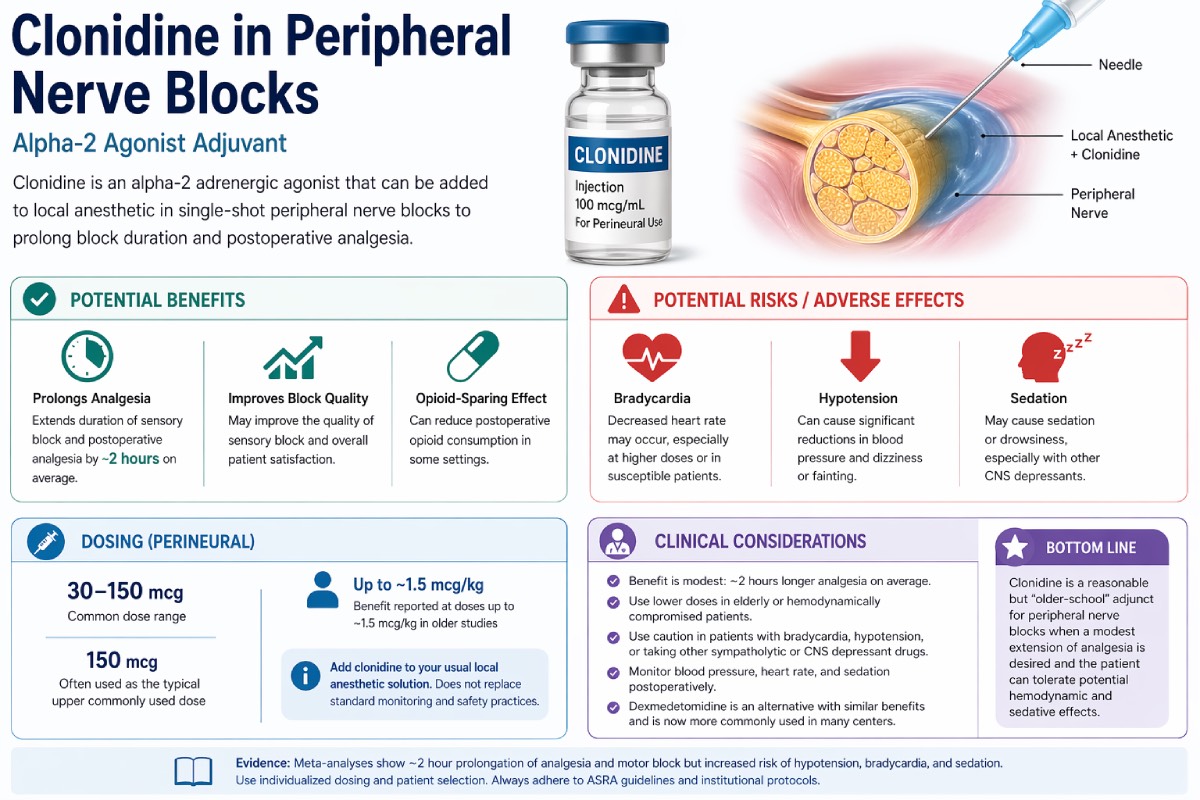
Clonidine ( 2-[(2,6-dichlorophenyl) amino]-2-imidazoline hydrochloride) is a drug that exerts its effects via its alpha-2 adrenergic agonism. It is commonly used to treat hypertension, attention deficit hyperactivity disorder, management of tics, cancer-related pain, and as an adjunct for neonatal opioid withdrawal syndrome.1 Recently, clonidine has also found use as an adjunct in peripheral nerve blocks.
A 2009 review of randomized placebo-controlled trials evaluating the therapeutic impact of the addition of clonidine to peripheral single-injection nerve or plexus blocks with local anesthetic in adults yielded data suggesting that clonidine prolongs the duration of postoperative analgesia (weighted mean difference 122 minutes; 95% confidence interval [CI] 74-169), sensory block (weighted mean difference 74 min; 95% CI 37-111), and motor block (weighted mean difference 141 min; 95% CI 82-199).2 Meanwhile, a systematic qualitative review of double-blind randomized controlled trials evaluating the efficacy of clonidine as an adjunct in peripheral nerve blocks yielded data supportive of the use of adjunctive clonidine for some peripheral nerve blocks consisting of intermediate-acting local anesthetics, given its ability to prolong the duration of analgesia and anesthesia. Additionally, side effects were found to be limited when administered doses were less than 150 μg.3
These effects were further substantiated by data published in a 2021 randomized controlled trial conducted in Ireland. In this study, patients receiving an ultrasound-guided axillary brachial plexus block were randomized to either local anesthesia plus normal saline or local anesthesia plus clonidine, at a dosage of 1 μg/kg. The median time to onset, for the clonidine group compared to the normal saline group, was shorter for both onset of sensory (5 min [5-7.5 interquartile range {IQR}] vs 10 min [8.8-12.5 IQR], respectively; p < 0.001) and motor (5 min [2.5-7.5 IQR] vs 7.5 min [6.3-7.5 IQR], respectively; p = 0.001) blockade.4 Further, the overall duration was longer for the clonidine versus the normal saline group, with respect to duration of both sensory (225 min [200-231 IQR] vs 168 min [148-190 IQR], respectively; p < 0.001) and motor (225 min [208-231 IQR] vs 168 min [148-186 IQR], respectively; p < 0.001) blockade.4
While the addition of clonidine to peripheral nerve blocks appears promising for pain relief, there are safety concerns due to its novelty. A 2026 systematic review of preclinical evidence yielded data suggesting high-doses of alpha-2 agonists may induce direct toxicity as evident in in vitro studies; however, this is not seen in vivo—even at supra-clinical dosing. Furthermore, alpha-2 agonist usage has been associated with neuroprotective qualities, as evidenced by reduced apoptosis, axonal degeneration, and inflammation.5
The data surrounding the use of clonidine as an adjunct in peripheral nerve blocks appears favorable. Its inclusion has been associated with shorter time to onset of pain relief, prolonged pain relief, and a favorable safety profile. While further research delineating exact dosing and additional pharmacokinetic and pharmacodynamic consequences are needed for further elucidation, current data suggests a clinical benefit to its inclusion.
References
1. Yasaei R, Saadabadi A. Clonidine. In: StatPearls. StatPearls Publishing; 2025. Accessed December 4, 2025. http://www.ncbi.nlm.nih.gov/books/NBK459124/
2. Pöpping DM, Elia N, Marret E, et al. Clonidine as an Adjuvant to Local Anesthetics for Peripheral Nerve and Plexus Blocks: A Meta-analysis of Randomized Trials. Anesthesiology. 2009;111(2):406-415. doi:10.1097/ALN.0b013e3181aae897
3. Mccartney C, Duggan E, Apatu E. Should We Add Clonidine to Local Anesthetic for Peripheral Nerve Blockade? A Qualitative Systematic Review of the Literature. Reg Anesth Pain Med. 2007;32(4):330-338. doi:10.1016/j.rapm.2007.02.010
4. Ranganath A, Hitka T, Iohom G. Effects of Clonidine as an Adjuvant to Lidocaine with Epinephrine in Ultrasound Guided Axillary Brachial Plexus Block: A Randomised Controlled Trial. J Clin Med. 2021;10(18):4181. doi:10.3390/jcm10184181
5. De Cassai A, Dost B, Bugada D, Boscolo A, Navalesi P. Safety of clonidine and dexmedetomidine in peripheral nerve blocks: a systematic review of preclinical evidence. Br J Anaesth. 2026;136(1):255-265. doi:10.1016/j.bja.2025.10.008