
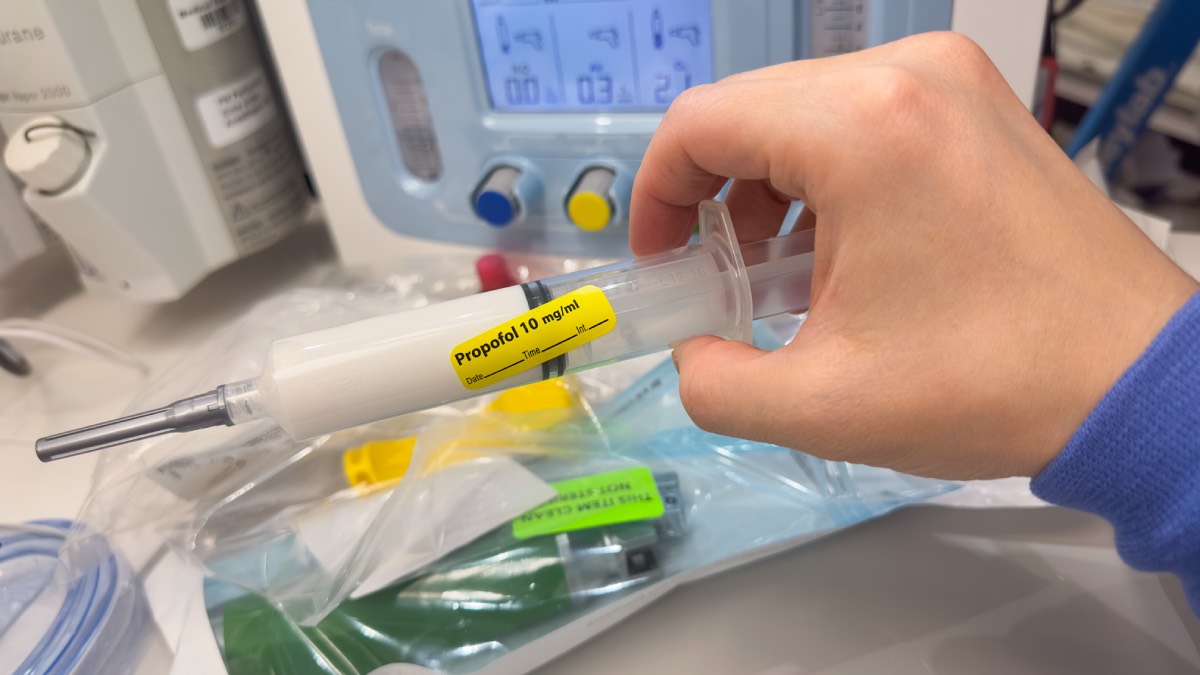
Sevoflurane and propofol are two commonly used anesthetic agents that are typically administered separately, but there is a small but growing body of research on the coadministration of these agents. Sevoflurane is an inhaled anesthetic known for its rapid onset and quick recovery due to its low blood–gas solubility. Propofol, an intravenous agent, is valued for its sedative, antiemetic, and smooth recovery properties. Coadministration may provide complementary effects that can enhance anesthesia while reducing the dose requirements of each agent (1).
Pharmacologically, sevoflurane and propofol interact in an additive manner, meaning their combined effect is approximately equal to the sum of their individual effects. This interaction is largely mediated through the γ-aminobutyric acid type A (GABA-A) receptor, where both drugs act through different binding sites but ultimately produce similar inhibitory effects on the central nervous system (1). Because of this additive relationship, clinicians can use lower concentrations of each drug to achieve the desired level of anesthesia, potentially reducing side effects associated with higher doses.
In a randomized controlled trial of patients undergoing gastrointestinal surgery, those who received both sevoflurane and propofol experienced faster recovery compared to those who received sevoflurane alone. Specifically, the time to awakening and extubation was significantly shorter in the combination group (2). In addition, patients receiving both agents had lower rates of emergence agitation and coughing, which are common complications during recovery from inhalational anesthesia (2). These findings suggest that adding propofol can make emergence from anesthesia smoother and more comfortable for patients.
The improved recovery profile can be explained by several potential mechanisms. First, using smaller doses of both drugs may allow faster elimination from the body. Second, propofol has known suppressive effects on airway reflexes, which helps reduce coughing and irritation during extubation. Third, propofol’s depressant effects on the central nervous system may reduce the risk of agitation, a phenomenon sometimes associated with sevoflurane anesthesia. These combined effects contribute to a more stable and predictable emergence phase.
Another advantage of sevoflurane and propofol coadministration is its impact on postoperative symptoms. Propofol has well-documented antiemetic properties, which may help reduce postoperative nausea and vomiting, a risk of volatile anesthetics. At the same time, sevoflurane has been associated with cardioprotective effects, particularly in patients undergoing cardiac procedures (3). By combining these agents, clinicians may be able to balance their benefits while minimizing their individual limitations.
Electroencephalographic studies further support the safe use of this combination. Monitoring tools such as the bispectral index (BIS) show that adequate depth of anesthesia can be maintained with lower concentrations of sevoflurane when propofol is added. This indicates that coadministration does not compromise anesthetic depth while still allowing dose reduction (4).
Despite these advantages, some limitations remain. The optimal dosing ratio of sevoflurane and propofol for coadministration is not fully established, and most studies use fixed or limited dosing strategies. Additionally, patient factors such as age, comorbidities, and type of surgery may influence the effectiveness of this approach. Further research is needed to determine the best protocols for different clinical scenarios.
References
1. Schumacher PM, Dossche J, Mortier EP, Luginbuehl M, Bouillon TW, Struys MM. Response surface modeling of the interaction between propofol and sevoflurane. Anesthesiology. 2009;111(4):790-804. doi:10.1097/ALN.0b013e3181b799ef
2. Liang C, Ding M, Du F, Cang J, Xue Z. Sevoflurane/propofol coadministration provides better recovery than sevoflurane in combined general/epidural anesthesia: a randomized clinical trial. J Anesth. 2014;28(5):721-726. doi:10.1007/s00540-014-1803-0
3. Jia L, Dong R, Zhang F, et al. Propofol Provides More Effective Protection for Circulating Lymphocytes Than Sevoflurane in Patients Undergoing Off-Pump Coronary Artery Bypass Graft Surgery. J Cardiothorac Vasc Anesth. 2015;29(5):1172-1179. doi:10.1053/j.jvca.2015.01.008
4. de Heer IJ, Raab HAC, Krul S, Karaöz-Bulut G, Stolker RJ, Weber F. Electroencephalographic density spectral array monitoring during propofol/sevoflurane coadministration in children, an exploratory observational study. Anaesth Crit Care Pain Med. 2024;43(2):101342. doi:10.1016/j.accpm.2023.101342